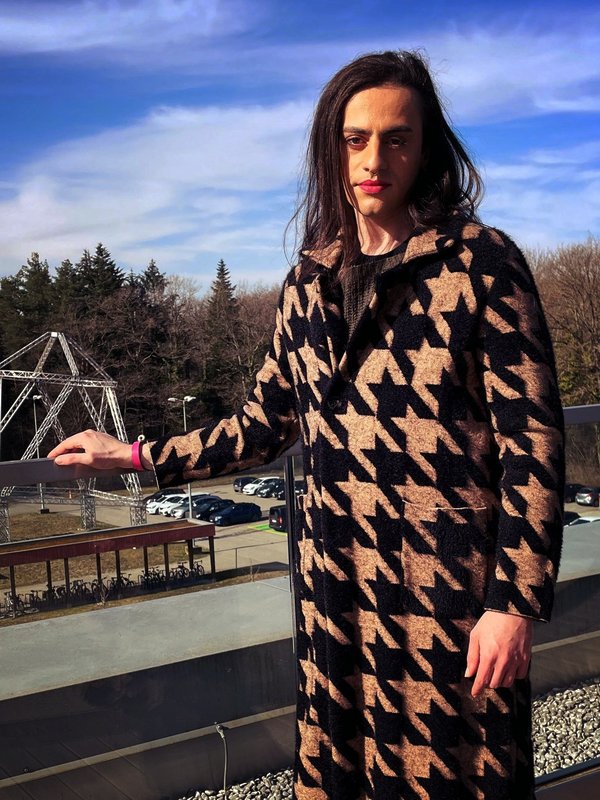
Dr. Mara Attia (they/them)
Exoplanet Scientist
SNSF Postdoc.Mobility Fellow, Kapteyn Astronomical Institute, University of Groningen
I study how planets between Earth and Neptune in size change over billions of years. Their orbits can migrate, their atmospheres escape to space, and their molten interiors trade gas with the atmosphere above. I build open-source models of these processes and use them to reconstruct the histories of planets observed today.
I did my PhD at the University of Geneva and moved to Groningen in 2025 on my own fellowship from the Swiss National Science Foundation, to work at the Kapteyn Astronomical Institute alongside Tim Lichtenberg's Forming Worlds Lab. Beyond my host group, I co-lead the Dutch node of a Cambridge–Toronto–Groningen collaboration on open model ensembles, abiotic baselines for interpreting exoplanet observations.
News
- Coming up: an invited talk at Exobiologie Jeunes Chercheur·ses (EJC) in Paris (2–4 November), and a seminar at the Laboratoire de Planétologie et Géosciences in Nantes.
- Coming up on 30 October: a talk on astronomy and my research for prospective students at the Open Day of the Faculty of Science and Engineering in Groningen.
- Seminar talks at the Institute of Astronomy, University of Cambridge.
- I co-convened the session Empowering the Next Generation of Planetary Scientists at the Europlanet Science Congress in The Hague, and gave a talk there.
- The PALEOS paper is out in A&A: PALEOS: Multiphase equations of state and mass–radius relations for exoplanet interiors, Attia et al. (2026), A&A 713, A225.
- New preprint, with me as second author: Super-Earth interiors shrink by about 10% as they crystallise, Lichtenberg, Attia, et al. (2026).
- New first-author preprint: Atmospheric escape fractionates secondary but not primary atmospheres, Attia & Lichtenberg (2026).
Research
Interiors
What a planet is made of, and whether its mantle is molten or solid, sets its radius and how much water and gas it can store. I wrote PALEOS to compute this.
Atmospheric escape
Starlight strips gas from close-in planets, and light species leave first. I work out how escape changes both the mass and the composition of an atmosphere.
Orbital histories
Many close-in planets did not form where we see them. I model how their orbits migrated and what the journey did to their atmospheres.
Open-source codes

PALEOS
Equations of state and mass–radius relations for iron, silicate, and water at planetary-interior conditions.


ZEPHYRUS
Atmospheric escape for planetary evolution models, which I am rebuilding around six escape regimes.
JADE
Coupled orbital dynamics and atmospheric escape of planets in three-body systems.
Upcoming talks
- November 2026Exobiologie Jeunes Chercheur·ses (EJC), Paris (France) invited talk
- November 2026Laboratoire de Planétologie et Géosciences, Nantes Université, Nantes (France) seminar
- January 2027Institut de Planétologie et d'Astrophysique de Grenoble, Université Grenoble-Alpes, Grenoble (France) seminar
Career
Positions
- 2025–presentSNSF Postdoc.Mobility Fellow
Kapteyn Astronomical Institute, University of Groningen (Groningen, Netherlands)
Education
- 2021–2024PhD in Astronomy and Astrophysics
University of Geneva (Geneva, Switzerland) - 2019–2021MSc in Physics (Astrophysics)
ETH Zurich (Zurich, Switzerland) - 2016–2019MSc in Science and Engineering
École Polytechnique (Paris, France)
Awards and grants
- July 2025Edith Alice Müller Award
Swiss Society for Astronomy and Astrophysics - May 2025Postdoc.Mobility Fellowship
Swiss National Science Foundation - March 2022Travel & Funding Award
Swiss Society for Astronomy and Astrophysics